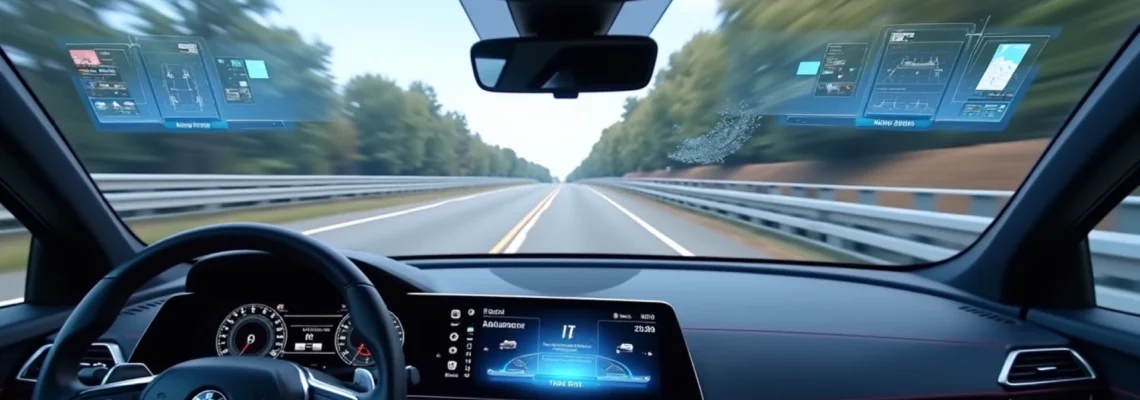
Modern automotive technology is experiencing a paradigm shift as augmented reality dashboards transform the fundamental relationship between drivers and their vehicles. These sophisticated systems overlay critical information directly onto the driver’s field of view, creating an intuitive interface that enhances navigation accuracy whilst maintaining optimal focus on the road ahead. Unlike traditional dashboard displays that require drivers to momentarily divert their attention, AR dashboards seamlessly integrate digital elements with the physical driving environment, resulting in safer and more efficient journeys. The technology represents a convergence of advanced optics, real-time data processing, and human-centred design principles that collectively redefine the automotive user experience.
Augmented reality Head-Up display technology architecture in modern vehicles
The foundation of effective AR dashboard systems lies in their sophisticated optical architecture, which must deliver crisp, high-contrast visuals whilst maintaining perfect alignment with real-world objects. Modern AR-HUD systems employ multiple layers of technology working in precise synchronisation to create the illusion that digital information exists naturally within the physical environment. These systems typically feature projection units housed within the dashboard, sophisticated optics for beam steering, and carefully engineered display surfaces that maintain visibility across diverse lighting conditions.
The core challenge in AR dashboard implementation centres on achieving optimal image quality whilst managing the complex interplay between ambient lighting, windscreen characteristics, and driver positioning. Advanced calibration algorithms continuously adjust projection parameters to maintain consistent visibility, regardless of external conditions such as bright sunlight or nighttime driving scenarios. This dynamic adaptation ensures that critical navigation information remains clearly visible without overwhelming the driver’s natural vision.
Temperature management represents another crucial aspect of AR-HUD architecture, as the high-intensity projection systems generate considerable heat that must be efficiently dissipated to prevent component degradation. Modern systems incorporate sophisticated thermal management solutions, including heat pipes and active cooling systems, to maintain optimal performance across extreme temperature ranges commonly encountered in automotive environments.
Waveguide optics and holographic elements in BMW idrive AR systems
BMW’s implementation of waveguide technology in their iDrive AR systems demonstrates the cutting-edge approach to optical efficiency and image quality. These systems utilise diffractive optical elements embedded within ultra-thin waveguides to direct light precisely towards the driver’s eye position. The waveguide approach offers significant advantages over traditional combiner-based systems, including reduced component size, improved image uniformity, and enhanced field-of-view capabilities.
The holographic elements within BMW’s system enable selective wavelength management, ensuring that projected images maintain optimal contrast against varying background conditions. This technology allows for precise control over colour saturation and brightness distribution, creating navigation overlays that appear naturally integrated with the road environment. The system’s ability to dynamically adjust holographic properties based on ambient lighting conditions represents a significant advancement in automotive display technology.
OLED projection systems and brightness calibration for Mercedes-Benz MBUX AR
Mercedes-Benz has pioneered the use of OLED technology in their MBUX AR systems, leveraging the superior contrast ratios and colour accuracy inherent in organic light-emitting diode displays. OLED projectors offer exceptional black levels and vibrant colour reproduction, crucial factors for maintaining information legibility against diverse road backgrounds. The technology’s ability to achieve true black pixels eliminates the light bleed common in LCD-based systems, resulting in sharper, more defined navigation overlays.
The brightness calibration algorithms employed in MBUX AR systems continuously monitor ambient light conditions through strategically positioned photosensors, automatically adjusting projection intensity to maintain optimal visibility. This adaptive brightness control prevents both eye strain in low-light conditions and information washout in bright sunlight scenarios. The system’s sophisticated algorithms account for factors such as windscreen tint, driver sunglasses, and seasonal lighting variations to deliver consistently optimal display performance.
Combiner glass integration with windscreen manufacturing processes
The integration of combiner glass elements within automotive windscreens represents a significant manufacturing challenge that requires precise coordination between glass suppliers and automotive manufacturers. Modern combiner integration techniques utilise specialised interlayer materials embedded within laminated windscreens, creating optically active zones without compromising structural integrity. These embedded elements must maintain perfect optical clarity whilst withstanding the mechanical stresses associated with vehicle operation and manufacturing processes.
Quality control during windscreen manufacturing becomes increasingly critical when combiner elements are integrated, as even minor optical distortions can significantly impact AR display quality. Advanced manufacturing techniques employ laser-based measurement systems to verify optical properties throughout the production process, ensuring that each windscreen meets the stringent requirements necessary for optimal AR performance. The manufacturing tolerances for AR-enabled windscreens are typically ten times tighter than those required for conventional automotive glass.
Field of view optimisation and angular resolution requirements
Optimising the field of view for AR dashboard systems requires careful consideration of human visual perception characteristics and typical driving scenarios. The horizontal field of view must be sufficient to accommodate navigation information across multiple traffic lanes whilst avoiding visual clutter that might distract from hazard detection. Current industry standards typically specify a minimum horizontal field of view of 10 degrees, with premium systems extending to 15 degrees or more to accommodate complex urban navigation scenarios.
Angular resolution requirements for AR dashboards are determined by the smallest visual elements that drivers must distinguish, such as lane boundaries or directional arrows. High-resolution systems achieve angular resolutions of 2-3 arcminutes, enabling crisp representation of fine details even at extended viewing distances. This level of resolution ensures that navigation symbols remain clearly defined and easily interpretable across the full range of driving distances and speeds commonly encountered in real-world operation.
Real-time data processing and sensor fusion for AR navigation overlays
The effectiveness of AR dashboard systems depends critically on their ability to process vast quantities of sensor data in real-time, creating accurate digital representations of the surrounding environment. Modern vehicles equipped with AR navigation systems typically incorporate dozens of sensors, including cameras, radar units, ultrasonic sensors, and GPS receivers, all contributing to a comprehensive understanding of vehicle position and environmental conditions. The challenge lies in fusing this disparate sensor data into a coherent, accurate representation that can support precise AR overlay positioning.
Sensor fusion algorithms employed in AR dashboard systems must operate within extremely tight latency constraints, typically processing sensor data and updating display outputs within 16-20 milliseconds to maintain synchronisation with human visual perception. This real-time processing requirement demands sophisticated computational architectures capable of parallel processing multiple data streams whilst maintaining deterministic timing characteristics. The systems must also incorporate robust error detection and correction mechanisms to ensure that sensor malfunctions or temporary data corruption do not compromise navigation accuracy.
The computational complexity of AR dashboard systems continues to increase as manufacturers integrate additional sensors and more sophisticated environmental understanding algorithms. Modern systems process data rates exceeding 1 gigabyte per second, requiring specialized automotive-grade processors designed to handle intensive computational loads whilst operating reliably in the challenging automotive environment. These processors must maintain performance across extreme temperature ranges whilst consuming minimal electrical power to avoid impacting vehicle efficiency.
Lidar point cloud processing with continental’s AR-HUD solutions
Continental’s implementation of LiDAR technology in their AR-HUD solutions demonstrates the sophisticated approach required to process three-dimensional point cloud data in real-time automotive applications. LiDAR sensors generate millions of distance measurements per second, creating detailed three-dimensional maps of the surrounding environment that enable precise object detection and classification. The processing of this point cloud data requires specialized algorithms capable of identifying relevant objects such as vehicles, pedestrians, and road infrastructure whilst filtering out irrelevant environmental noise.
The integration of LiDAR data with AR dashboard systems enables highly accurate object highlighting and distance estimation, providing drivers with enhanced situational awareness in complex traffic scenarios. Continental’s systems employ machine learning algorithms trained on millions of driving scenarios to accurately classify objects within the LiDAR point cloud, ensuring that AR overlays correctly identify and highlight relevant hazards or navigation waypoints. The processing pipeline includes sophisticated tracking algorithms that maintain object identity across multiple sensor frames, enabling smooth and consistent AR overlay behaviour.
GPS precision enhancement through RTK corrections and SLAM algorithms
Achieving the centimetre-level accuracy required for effective AR navigation overlays demands sophisticated GPS enhancement techniques beyond standard consumer-grade positioning systems. Real-Time Kinematic (RTK) correction systems provide the precision necessary for accurate AR overlay positioning, utilising reference stations to eliminate atmospheric and satellite-based positioning errors. These systems can achieve horizontal positioning accuracy of 2-5 centimetres, sufficient for precise lane-level navigation guidance in AR dashboard applications.
Simultaneous Localisation and Mapping (SLAM) algorithms complement GPS-based positioning by creating detailed maps of the local environment whilst simultaneously determining vehicle position within those maps. SLAM technology proves particularly valuable in urban environments where GPS signals may be degraded by tall buildings or in tunnels where satellite positioning becomes temporarily unavailable. The integration of SLAM with AR dashboard systems enables continuous, accurate overlay positioning even in challenging environments where traditional GPS systems might struggle.
Computer vision lane detection using mobileye EyeQ chipsets
Mobileye’s EyeQ chipsets represent the current state-of-the-art in automotive computer vision processing, providing the computational power necessary for real-time lane detection and road geometry analysis. These specialized processors incorporate dedicated neural processing units optimized for the specific algorithms required in automotive vision applications. The EyeQ architecture enables processing of high-resolution camera feeds whilst maintaining the low power consumption essential for automotive applications.
Lane detection algorithms implemented on EyeQ chipsets utilise convolutional neural networks trained on millions of road images to identify lane boundaries across diverse conditions including varying lighting, weather, and road surface types. The systems must accurately detect not only clearly marked lanes but also construction zones, temporary lane configurations, and partially obscured markings common in real-world driving scenarios. This robust lane detection capability provides the foundation for accurate AR navigation overlays that can guide drivers precisely within traffic lanes.
Inertial measurement unit calibration for motion compensation
Inertial Measurement Units (IMUs) provide critical motion data that enables AR dashboard systems to compensate for vehicle movement and maintain stable overlay positioning. High-precision IMUs measure acceleration and angular velocity across three axes with sufficient accuracy to detect even subtle vehicle movements that might otherwise cause AR overlays to appear unstable or misaligned. The calibration of these sensitive instruments requires sophisticated algorithms that can distinguish between actual vehicle motion and sensor noise or drift.
Motion compensation algorithms utilise IMU data to predict and correct for vehicle movement between sensor measurements, ensuring that AR overlays remain properly aligned with real-world objects despite the vehicle’s motion. This compensation proves particularly important during cornering manoeuvres or when driving over uneven road surfaces that might otherwise cause AR displays to appear jittery or unstable. The integration of IMU data with other sensor inputs creates a comprehensive understanding of vehicle dynamics that supports smooth, natural-appearing AR overlay behaviour.
Machine learning model inference latency optimisation
The deployment of machine learning models within AR dashboard systems requires careful optimization to achieve the inference speeds necessary for real-time operation whilst maintaining accuracy in object recognition and scene understanding. Modern automotive AI processors incorporate specialized neural processing units designed to accelerate the matrix operations fundamental to deep learning algorithms. These optimizations enable complex models to process sensor data within the strict timing constraints required for AR applications.
Model compression techniques play a crucial role in achieving optimal performance on automotive hardware platforms, with quantization and pruning algorithms reducing model complexity whilst preserving accuracy. These optimization techniques enable deployment of sophisticated computer vision models that might otherwise require excessive computational resources. The balance between model accuracy and inference speed requires careful tuning for each specific application, ensuring that AR dashboard systems can respond quickly to changing road conditions whilst maintaining reliable object detection and classification performance.
Advanced driver assistance system integration with AR dashboard elements
The integration of Advanced Driver Assistance Systems (ADAS) with AR dashboard technology represents a fundamental shift towards more intuitive and effective vehicle safety systems. Modern ADAS implementations generate vast amounts of information about vehicle surroundings, potential hazards, and recommended driving actions, but traditional warning systems often struggle to communicate this information effectively to drivers. AR dashboards transform this challenge by presenting ADAS information through natural, spatially-contextual visual cues that align perfectly with the driver’s view of the road ahead.
The synergy between ADAS and AR systems creates opportunities for more nuanced and effective driver assistance than either technology could achieve independently. For example, adaptive cruise control systems can display the target vehicle being tracked with subtle highlighting visible through the AR dashboard, providing immediate visual confirmation of system status. Similarly, lane departure warning systems can present correction suggestions through gentle visual cues overlaid directly onto lane boundaries, creating an intuitive guidance system that feels natural rather than intrusive.
Forward collision warning systems benefit tremendously from AR dashboard integration, as traditional audible and visual alerts often fail to clearly identify the specific hazard requiring attention. AR systems can highlight potential collision risks with contextual visual indicators that immediately direct the driver’s attention to the relevant area of the road. This spatial awareness enhancement proves particularly valuable in complex traffic scenarios where multiple potential hazards might exist simultaneously, allowing the AR system to prioritise and present warnings in order of urgency and relevance.
The integration of ADAS with AR dashboard technology reduces driver response times by an average of 0.8 seconds compared to traditional warning systems, representing a significant improvement in collision avoidance capability.
Parking assistance systems demonstrate another area where AR integration provides substantial benefits over conventional approaches. Traditional parking sensors provide distance information through audible beeps or simple visual displays, requiring drivers to mentally translate this information into spatial awareness. AR parking systems overlay trajectory predictions and obstacle warnings directly onto the driver’s view, creating an intuitive guidance system that eliminates guesswork and significantly reduces the likelihood of parking-related accidents.
Cognitive load reduction through contextual information layering
The primary advantage of AR dashboard systems lies in their ability to present information within the context of the driver’s natural field of view, significantly reducing the cognitive processing required to interpret and act upon navigation and vehicle information. Traditional dashboard displays require drivers to repeatedly shift their attention between the road and instrument panels, creating cognitive interruptions that can impair hazard detection and response capabilities. AR systems eliminate this divided attention challenge by overlaying critical information directly onto the road view, allowing drivers to maintain continuous visual contact with their surroundings.
Contextual information layering techniques employed in modern AR dashboards prioritise information presentation based on relevance, urgency, and driver workload assessment. The systems continuously evaluate driving conditions and adjust information density accordingly, presenting detailed navigation guidance during low-stress highway cruising whilst reducing display complexity in demanding urban environments. This adaptive information management ensures that drivers receive optimal support without experiencing information overload that might compromise safety.
The psychological benefits of contextual information presentation extend beyond simple attention management to encompass broader aspects of driver confidence and situational awareness. When navigation information appears naturally integrated with the road environment, drivers report higher confidence levels and reduced stress during challenging navigation scenarios. This psychological advantage translates into measurable improvements in driving performance, with studies indicating reduced lane deviation and smoother speed control when using AR navigation systems compared to traditional GPS displays.
Attention management theory applied to audi virtual cockpit AR features
Audi’s implementation of attention management principles in their Virtual Cockpit AR features demonstrates sophisticated understanding of human perceptual limitations and cognitive processing capabilities. The system employs selective information filtering based on established psychological research regarding human attention capacity, ensuring that AR overlays support rather than overwhelm natural visual processing. Audi’s approach incorporates dynamic saliency mapping that adjusts information prominence based on current driving demands and identified attention patterns.
The Virtual Cockpit system utilises pre-attentive processing principles to guide driver attention through carefully designed visual cues that operate below conscious awareness thresholds. These subtle guidance mechanisms help direct visual attention toward relevant information without creating the distraction associated with more obvious visual alerts. The implementation includes sophisticated timing algorithms that present information precisely when drivers are most likely to benefit from additional guidance, such as during complex intersection approaches or highway merge scenarios.
Peripheral vision preservation in tesla model S AR interface design
Tesla’s approach to AR interface design in the Model S emphasises preservation of natural peripheral vision capabilities while enhancing central vision information processing. The system recognises that peripheral vision plays a crucial role in hazard detection and general situational awareness, ensuring that AR overlays do not interfere with these essential visual functions. Tesla’s implementation utilises carefully controlled contrast ratios and transparency levels to maintain peripheral vision sensitivity whilst providing clear central information display.
The Model S AR interface incorporates adaptive brightness control algorithms that respond not only to ambient lighting conditions but also to driver eye adaptation states, ensuring optimal visibility across varying environmental conditions. The system’s design philosophy prioritises minimalist information presentation that enhances rather than replaces natural visual processing, creating an interface that feels intuitive and supportive rather than technological and intrusive. This approach requires sophisticated understanding of human visual system capabilities and limitations.
Information hierarchy optimisation for Multi-Modal sensory processing
Modern AR dashboard systems must accommodate the complex nature of human multi-modal sensory processing, recognising that drivers simultaneously process visual, auditory, and tactile information streams. Information hierarchy optimisation ensures that critical safety information receives appropriate prioritisation across all sensory channels, with visual AR displays coordinated with
auditory feedback and haptic warnings to create coherent, non-conflicting sensory experiences. The optimisation process considers factors such as information processing speed across different sensory modalities, ensuring that time-critical safety information reaches driver awareness through the most appropriate combination of channels.
The hierarchy optimisation algorithms continuously assess cognitive load indicators derived from driving behaviour patterns, eye tracking data, and physiological monitoring systems where available. This real-time assessment enables dynamic adjustment of information presentation strategies, reducing visual information density when drivers demonstrate signs of high cognitive workload whilst increasing alertness cues during periods of potential inattention. The adaptive multi-modal approach ensures that critical navigation and safety information consistently penetrates driver awareness without overwhelming cognitive processing capabilities.
Eye-tracking integration with tobii automotive solutions
Tobii’s automotive eye-tracking solutions provide unprecedented insights into driver attention patterns, enabling AR dashboard systems to optimise information placement based on natural gaze behaviours. The technology utilises infrared illumination and high-speed cameras to monitor eye movements with sub-degree accuracy, creating detailed maps of visual attention distribution during driving tasks. This granular understanding of where drivers naturally look enables AR systems to position critical information within zones of high visual attention whilst avoiding areas typically outside normal scanning patterns.
The integration of eye-tracking data with AR dashboard systems creates opportunities for predictive information presentation, where the system anticipates information needs based on observed attention patterns. For example, when eye-tracking indicates a driver is scanning for lane change opportunities, the AR system can proactively highlight available gaps in traffic or display blind spot warnings with enhanced prominence. This anticipatory assistance approach transforms AR dashboards from reactive information displays into proactive driving support systems that enhance natural driving behaviours.
Tobii’s solutions also enable attention-based interface adaptation, automatically adjusting AR overlay characteristics based on individual driver visual behaviour patterns. The system learns from repeated observations of driver attention distribution, identifying optimal locations for different types of information presentation. This personalisation capability ensures that AR displays align with individual visual scanning habits, maximising information effectiveness whilst minimising distraction potential. The eye-tracking integration proves particularly valuable for detecting driver fatigue or distraction states, enabling appropriate system responses to maintain safety.
Turn-by-turn navigation enhancement via spatial audio and visual cues
The integration of spatial audio technology with AR dashboard systems creates a comprehensive navigation experience that engages multiple sensory channels whilst maintaining driver focus on road conditions. Spatial audio enables precise directional guidance through three-dimensional sound positioning, allowing navigation systems to indicate turn directions through audio cues that appear to originate from the actual turning location. This audio-visual synchronisation eliminates the ambiguity common in traditional turn-by-turn directions, particularly in complex intersection scenarios where visual landmarks may be obscured or confusing.
Modern spatial audio implementations utilise advanced digital signal processing algorithms to create convincing three-dimensional audio environments within vehicle cabins. The technology accounts for individual head positioning, seat adjustment, and cabin acoustics to ensure accurate sound localisation across different driver positions and vehicle configurations. The personalised spatial audio calibration process adapts to individual hearing characteristics and preferences, optimising the navigation experience for each specific user whilst maintaining consistency across different driving scenarios.
The combination of spatial audio with AR visual navigation creates redundant guidance channels that enhance navigation reliability in challenging conditions. When visual AR overlays become difficult to read due to bright sunlight or weather conditions, spatial audio provides alternative guidance that maintains navigation effectiveness. Conversely, in noisy driving environments where audio guidance might be compromised, AR visual cues ensure continuous navigation support. This multi-modal approach significantly improves navigation success rates, particularly in unfamiliar urban environments where traditional GPS systems often struggle with accuracy.
Advanced turn-by-turn systems incorporate predictive routing algorithms that analyse traffic patterns, road conditions, and driver preferences to optimise route selection continuously. The AR dashboard presents these dynamic route adjustments through smooth visual transitions that clearly communicate routing changes without causing confusion or requiring immediate driver response. The spatial audio component reinforces routing changes through gentle auditory cues that prepare drivers for upcoming manoeuvres, creating a seamless navigation experience that feels natural and supportive rather than demanding or intrusive.
Safety protocol implementation and regulatory compliance standards
The implementation of AR dashboard systems must navigate a complex landscape of automotive safety regulations and industry standards that continue to evolve as the technology matures. Current regulatory frameworks, including those established by the National Highway Traffic Safety Administration (NHTSA) and European Commission, emphasise the fundamental principle that driver assistance technologies must not create additional hazards or substantially increase driver workload. AR dashboard implementations must demonstrate compliance with established distraction guidelines whilst proving their safety benefits through rigorous testing protocols.
ISO 26262 functional safety standards provide the framework for developing AR dashboard systems that meet automotive industry requirements for safety-critical applications. The standard mandates comprehensive hazard analysis and risk assessment procedures that identify potential failure modes and their consequences. AR dashboard systems must incorporate multiple layers of redundancy and fail-safe mechanisms to ensure that system malfunctions cannot compromise vehicle safety. The Automotive Safety Integrity Level (ASIL) classifications guide development priorities, with navigation-critical functions typically requiring ASIL-B or higher compliance levels.
Quality assurance protocols for AR dashboard systems extend beyond traditional software testing to encompass optical performance validation, human factors verification, and long-term reliability assessment. The testing procedures must account for the wide range of environmental conditions encountered in automotive applications, including extreme temperatures, vibration, electromagnetic interference, and varying lighting conditions. Validation testing typically requires hundreds of thousands of kilometres of real-world driving data across diverse geographical and climatic conditions to demonstrate consistent performance and safety.
Regulatory compliance requires comprehensive documentation of system design decisions, safety analysis results, and validation testing outcomes. The documentation must demonstrate that AR dashboard implementations provide measurable safety benefits without introducing unacceptable risks or substantially increasing cognitive workload. Industry collaboration through organisations such as the Society of Automotive Engineers (SAE) continues to develop standardised testing methodologies and performance criteria that will guide future regulatory requirements. The evolving regulatory landscape requires ongoing monitoring and adaptation to ensure continued compliance as AR dashboard technology advances and deployment scales increase.
Data privacy and cybersecurity considerations represent emerging regulatory focus areas as AR dashboard systems increasingly rely on cloud-based processing and vehicle-to-infrastructure communication. Compliance frameworks must address data collection, storage, and transmission practices whilst ensuring that cybersecurity measures do not compromise system responsiveness or safety performance. The integration of AR dashboard systems with broader vehicle architectures requires comprehensive security assessment to prevent potential vulnerabilities that could be exploited by malicious actors. These considerations become increasingly important as AR dashboard systems evolve toward greater connectivity and integration with smart city infrastructure.